

Grounded S02 E03
There’s a kind of exhaustion that doesn’t come from working too hard. It comes from working on the wrong things.
Imagine you’re a marathon runner, but instead of running the race, you’re spending all your energy maintaining the track, organizing the water stations, managing the volunteers, and promoting the event. You’re exhausted, but you haven’t actually run a single mile.

That’s what’s happening to millions of Christians in ministry today.They’re not tired from doing kingdom work. They’re tired from running the church machine.They’re not exhausted from making disciples. They’re exhausted from managing programs, budgets, buildings, and committees.
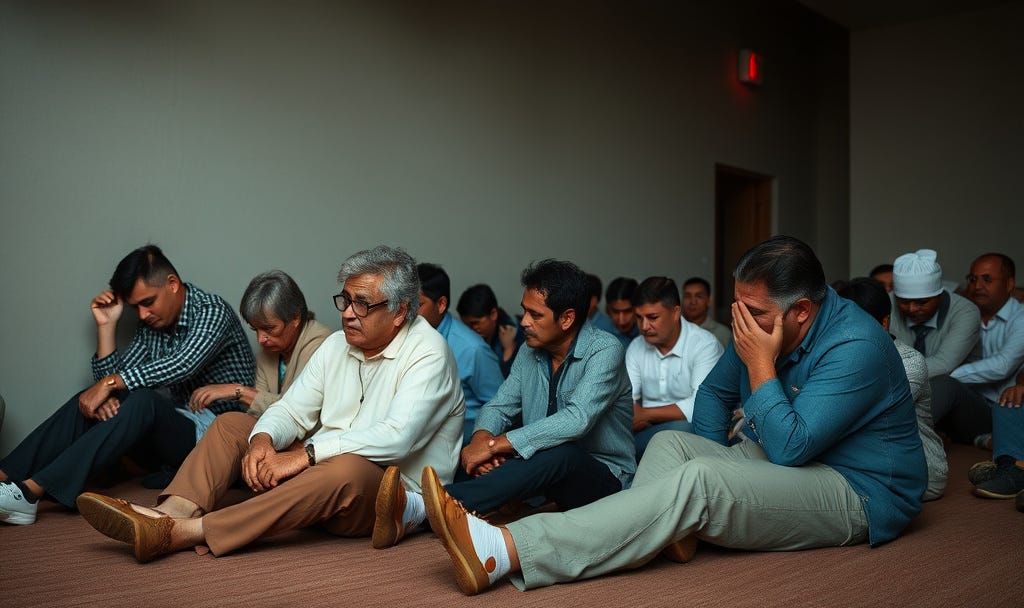
They’re not burned out from encountering Jesus for too many hours each week. They aren’t weary from all the disciples they’ve been training. They’re burned out from maintaining an institution that increasingly feels disconnected from His core mission.
This is the relentless slow erosion of our energy. And it’s one of the most dangerous crises facing the church today. Because when the people who are supposed to be leading us closer to Jesus are themselves running on empty, what hope is there for the rest of us?
Today’s topic.
Today, we’re going to talk about what it’s like to serve in ministry while feeling increasingly disconnected from the presence and power of Jesus. We’ll explore why so many faithful servants are burning out, and what it means for the future of the church.
Quick Recap: In our first episode, we talked about the quiet exodus—the 40 million Americans who have left the church. In our second episode, we explored the paradox at the heart of that exodus—how you can be drawn to Jesus and repelled by Christianity. Today, we’re turning our attention to those who haven’t left. Those who are still showing up, still serving, still leading—but who are slowly dying inside.
Maybe that’s you.
Maybe you’re a pastor who started ministry with fire in your heart, but now you’re just trying to survive another Sunday. Maybe you’re a worship leader who used to feel God’s presence when you sang, but now it feels like you’re just performing.
Maybe you’re a volunteer who used to love serving, but now it feels like an obligation. If that’s you, I want you to know that what you’re experiencing is a symptom of a much larger problem—a problem with the system itself, not with you.
So let’s talk about it: Running the Church Machine We’ve All Inherited

The Experience Business
Imagine sitting down with a friend of yours named David. David planted a church 15 years ago with a vision to create a community where people could encounter Jesus, grow as disciples, and serve the world. He was passionate, energetic, and deeply committed to following Jesus. If you sit down with David recently he looks exhausted. Not the kind of tired you get from a long week—the kind of tired that comes from years of carrying a weight you were never meant to carry.
He says, “I didn’t sign up for this.”
“For what?” you ask.
“For running a business. For managing staff conflicts. For fundraising. For building maintenance. For navigating denominational politics. For keeping the board happy. For competing with the megachurch down the street.”
He pauses, then says, “I wanted to make disciples. But I spend 90% of my time managing an experience business.”
David’s story isn’t unique. It’s the norm. Here’s what happens: You start with a vision to follow Jesus and help others do the same. But over time, the institution takes over. The programs multiply. The budget grows. The staff expands. The building needs maintenance. The staff need managing. The donors need stewarding.
And before you know it, you’re not a pastor anymore—you’re a CEO.
You’re not making disciples—you’re managing a machine. And the machine is hungry. It demands more time, more energy, more resources. It never says, “That’s enough.” It always says, “More.” So you give more. You work longer hours. You sacrifice time with your family. You neglect your own inner life. You push through the exhaustion, and slowly, imperceptibly, the fire that once burned in your heart begins to dim.
But it’s not just pastors who are experiencing this. It’s also many who are trying to faithfully serve in the church system as staff or volunteer.

Five Signs of Ministry Burnout
If you’re serving in ministry—whether as a pastor, a staff member, or a volunteer—you probably recognize some of these symptoms:
1. You’re emotionally exhausted.
You used to feel energized by ministry. Now you feel drained. Even thinking about Sunday morning makes you tired. You’re going through the motions, but your heart isn’t in it anymore. You’re running on fumes.
2. You’re bone dry inside.
You used to encounter Jesus in worship, in prayer, in Scripture. Now it feels like He’s distant, silent, absent. You’re teaching others about Jesus, but you’re not experiencing Him yourself. You’re giving out of an empty well.
3. You’re becoming cynical.
You used to believe that the church could change the world. Now you’re not so sure. You’ve seen too many scandals, too much hypocrisy, too many people leave. You’ve become jaded, skeptical, disillusioned. You don’t trust the system anymore
4. You’re quietly resentful.
You used to serve with joy. Now you serve out of obligation. You resent the people who don’t show up, who don’t give, who don’t volunteer. You resent the demands on your time, the expectations placed on you, the lack of appreciation. You’re angry, and you don’t know what to do with it.
5. You’re questioning everything.
You used to be certain about your calling, your theology, your purpose. Now you’re not sure about anything. Is this really what Jesus wanted? Is this really what the church is supposed to be? Am I even making a difference? Should I just quit?
If you’re experiencing these symptoms, as a couple with over 25 years in pastoral ministry, Sherry and I can empathize with you. You were never meant to run a machine. You were meant to follow Jesus and help others do the same.
Faith That Requires Constant Effort Is Unsustainable
One of the quiet assumptions in many Christian spaces is that faith is supposed to be hard in the sense of constantly demanding more energy, more commitment, more resilience. But when faith consistently drains without restoring, something is misaligned. Jesus spoke often of rest, lightness, and renewal—not as exceptions, but as the daily reward for walking in His way.
Jesus Calls to the Weary
Jesus once said, “Come to me, all who are weary and burdened, and I will give you rest.”
Notice what He didn’t do:
He didn’t scold the weary
He didn’t question their sincerity
He didn’t tell them to just push through
He assumes weariness is part of the human condition, but he points those who are weary to a sure solution.
Jesus is Our Oasis
In this verse, Jesus positions Himself, not a system, a retreat center, or a long vacation, as the place of rest, the shelter…direct fellowship with Jesus is the oasis for weary seekers.
If you are weary from your ministry, my friend, let Jesus fill you up right now. Let his strong arms comfort you. Just stop reading now and let him do his work of restoration.
So how did we get here? How did ministry become so exhausting?
From Movement to Institution
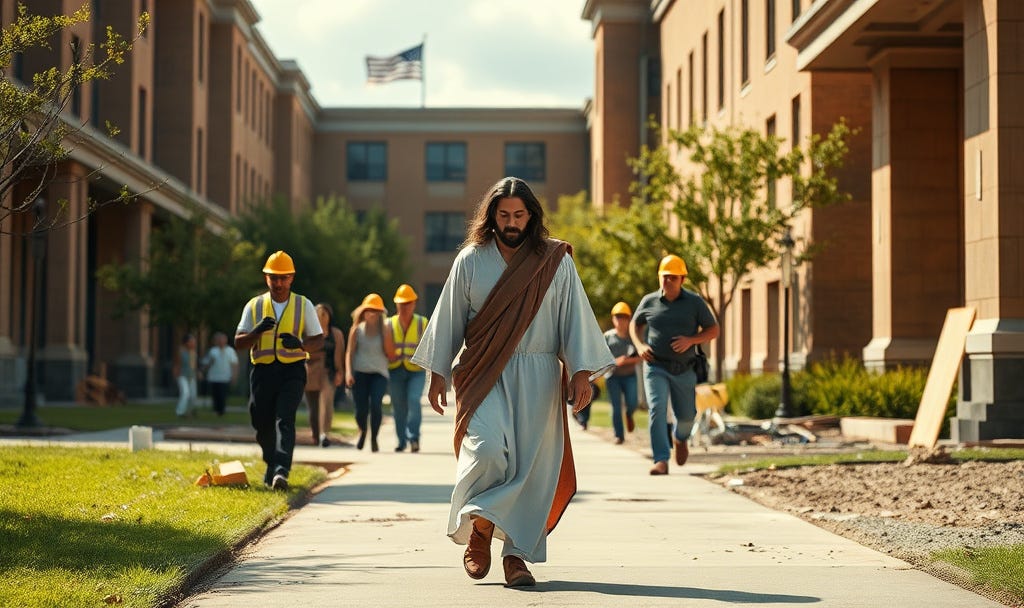
Jesus didn’t start an institution. He started a movement. He gathered a small group of disciples, taught them how to live in the kingdom of God, and sent them out to make more disciples. It was simple, organic, reproducible. But over time, that movement became an institution.
And institutions have a way of prioritizing their own survival over their original mission.
Here’s how it happens:
Step 1: A movement grows. More people join. More communities form. More leaders emerge. This is good—it’s what Jesus wanted.
Step 2: The movement organizes. To manage the growth, structures are put in place. Roles are defined. Processes are created. Buildings are built. This is necessary—organization isn’t bad.
Step 3: The organization becomes an institution. This is where things change. To an institution, perpetuating the structure, even enlarging it, becomes priority. More departments, more buildings, more employees, more budget. Any institution will prioritize its own survival over its original purpose.
Step 4: The institution demands maintenance. Now, instead of making disciples, we prop up a massive, aging institution. Instead of being the church, we’re doing church. We run the machine.
This isn’t a new problem. It’s happened a million times throughout history.
The Cost of the Erosion
What happens when the people leading the church are running on empty? When ministry leaders become exhausted from institutional maintenance—running the machine, here’s what we lose:
1. We lose prophetic witness. Prophets challenge the status quo. Institutions ARE status quo. The older and bigger they are the more fiercely they resist change, or correction, or downsizing.
2. We lose authentic community. Community requires presence, vulnerability and …the most scarce resource of all—spare time. When you’re running from meeting to meeting, managing crisis after crisis, you don’t have time for deep relationships. You have transactions, not transformations.
3. We lose spiritual vitality. You can’t give what you don’t have. If your own soul is dry, you can’t water anyone else’s.
4. We lose the next generation. Young people can smell inauthenticity a mile away. They can tell when you’re going through the motions. They can see when the institution matters more than the mission. And they’re walking away in droves.
5. We lose the presence of Jesus. This is the most tragic cost of all. You might think this is impossible, I mean, how can you have church or Christianity without Jesus?
The answer is in the first few chapters of the Revelation of Saint John, where Jesus addresses fledgling Christian communities across Asia Minor, and points to character and obedience flaws within this earliest example of Christianity.
His threat to them is always the same. “Fix it or you can do this by yourself. I will remove your candlestick.” As far as I can tell, that means their participation in his presence and mission.
So what do we do? How do we stop the erosion?
In the coming episodes, we’re going to explore what that looks like practically. We’re going to talk about how to ReJesus everything—theology, mission, church, discipleship. We’re going to rediscover the simple, life-giving way of Jesus.
But first, we have to acknowledge the cost of staying where we are.
Because the slow erosion of energy isn’t just a personal problem—it’s a systemic problem. And it’s killing the church from the inside out. We are standing at a crossroads as Christian people. We will either reform our ways and the systems we have created, or we will watch them crumble in our lifetime.
Charting Our Discussion Progress So Far
We’ve talked about the quiet exodus—the people who are leaving. We’ve explored the paradox—how you can be drawn to Jesus and repelled by Christianity. And today, we’ve looked at the slow erosion of energy—what it’s like to serve in ministry while being depleted by institutional maintenance .
But there’s one more piece of the pain we need to address.
It’s that we’re living in a time when having convictions—really believing something and standing by it—comes at a cost.
In our next episode, we’re going to talk about the privilege and the cost of having convictions. We’ll explore what it means to hold firm beliefs in a culture that demands conformity or silence.
We’ll look at why conviction is both a gift and a burden. And we’ll ask the question: Is it worth it?
Because if we’re going to ReJesus Everything, we’re going to need conviction. We’re going to need people who are willing to stand firm, even when it costs them something.
If you’re someone who’s tired of compromising, tired of going along with the crowd, tired of staying silent—this next episode is for you.
Discussion Question: What part of your faith currently requires the most effort to maintain, and what do you think that effort is costing you?


