

Writer’s Note: Starting with this episode, the newsletter version will be a summary of the video, not a transcript. There’s lots more in the video. Feel free to listen to it at 1.5 speed if your time is short. (That’s what I always do with podcasts.) Please help us grow this podcast. The crisis facing our faith is a crucial issue, and we’ve got to build a better church going forward.
The Everything Religion: Christianity’s Crisis of No Center
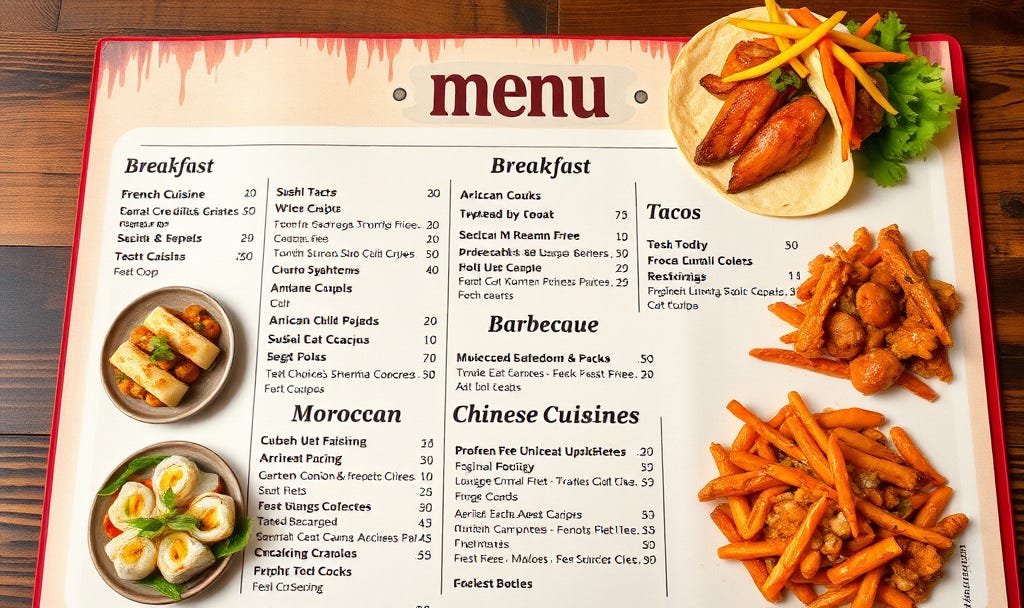
Imagine walking into a restaurant and being handed a 200-page menu with 847-items — breakfast, sushi, tacos, French cuisine, barbecue, Moroccan, African, and Chinese cuisine. Maybe you’d love it, or maybe you’d turn around and walk out.
A kitchen that tries to make everything usually does nothing well. There’s no identity, no specialty, no standard of excellence. Just an overwhelming array of options designed to keep everyone happy. Would you trust it? Probably not.
That’s what Christianity has become.
It is the world’s largest spiritual buffet. Walk in and take whatever you like — grace without repentance, heaven without hell, Jesus without the cross, community without commitment. You can construct a Jesus who endorses your politics, blesses your lifestyle, and never once asks you to change. And nobody, anywhere, is in charge of the kitchen.
A City Without a Government

In my book, ReJesusEverything which is coming out in about a month, I describe Christianity this way: if Christianity were a city, it would be Tokyo.
If you’ve ever been to Tokyo, you know it’s overwhelming. It’s the largest metropolitan area on the planet — 40 million people. Ancient Shinto temples sit in the shadows of glass skyscrapers. Buddhist monks in robes walk past businessmen in suits. Robots clean floors while women serve tea in traditional kimonos. It’s simultaneously ancient and futuristic, orderly and chaotic, beautiful and bewildering.
Christianity is like that.
Christianity holds one-third of all humans on earth. It’s richer in money and history than most nations. Long ago it overwhelmed the boundaries of being a religion and became something else entirely — a global enterprise, a civilization, a culture, a political force, a business ecosystem.
But here’s the critical difference: Tokyo has a government. Christianity doesn’t.
Tokyo has a mayor, a city council, laws, courts, and enforcement mechanisms. When disputes arise, there is a system to resolve them. Christianity has none of that. There is no global authority. No universal council. No mechanism to resolve disputes or enforce standards. And the result is that Christianity has become whatever anyone wants it to be.
Whatever You Practice Is a Minority Position
Here’s something that may surprise you: whatever version of Christianity you practice is followed by no more than 25% of the world’s 2.4 billion Christians.
Think about that. If you’re a Pentecostal, your understanding of baptism, salvation, church governance, and spiritual gifts is shared by a small minority of global Christians. The same is true if you’re Catholic, Baptist, Reformed, Eastern Orthodox, or Non-denominational. There is no majority position. There is no standard version.
Simply said, there are many Christian faiths — all using the same name, all claiming the same founder, all reading the same Bible — and all arriving at dramatically different conclusions. Christianity today encompasses every denomination you can name, plus seventh-day Adventism, Universalism, Christian Science, Mormonism, Jehovah’s Witnesses, and dozens of other groups that claim the name of Jesus while holding beliefs traditional Christianity would consider heretical.
Is Jesus the chairman of the board of all of this? Honestly, no. He’s the logo on the letterhead, but he’s not running the organization — because there is no organization. There aren’t two or three Christianities. There are 47,000, and they contradict each other in doctrine and lifestyle, even on foundational questions like: how does a person come into a right relationship with God?

The Buffet Problem
The buffet metaphor cuts deeper than it first appears. A buffet feels like freedom. It feels like you’re being respected, like your preferences matter, like you’re not being forced into a box. But what it actually produces is a faith with no spine.
A Christianity constructed from a buffet line can’t challenge you, because you’ve already pre-selected everything that confirms what you already believe. It gives you a Jesus who endorses your existing lifestyle rather than calling you into transformation.
The Apostle Paul warned Timothy that a time would come when people would not endure sound teaching, but would accumulate teachers to suit their own passions and turn away from truth. That time has arrived. Most people standing in the buffet line don’t realize what they’re doing. They think they’re being discerning. They think they’re following their conscience. But they are actually constructing a customized religion that costs nothing and demands nothing — and therefore produces nothing.
The Symptoms Are Everywhere

When I was a kid the churches we attended were normal except for one curious item. In these simple, humble buildings, filled with working-class people hungry for God — one thing was nearly universal: the pastor’s chair. Not just any chair. A throne. Velvet fabric. Elevated on the platform. No one else permitted to sit in it. Who thought this up? I never knew, but they were pretty much universal.
Spend one hour reading the Gospels and you know Jesus would have hurled those chairs out of the building. He spent his ministry turning upside down every system that elevated the powerful over the humble, especially within Judaism. And yet the chairs were everywhere, unchallenged, for decades — because there was no center to measure them against.
The chairs eventually got moved when churches built massive performance stages and the thrones no longer fit the aesthetic. But it shouldn’t have taken a stage redesign. It should have taken Jesus.
The Way Back
The early church had a simple doctrine: Jesus is Lord. That was enough. Everything else had to fit inside that one conviction. Jesus held all authority. His word was final. That was the center, and everything else orbited around it.
We’ve lost that center. And without it, we have no compass, no magnetic north, no authoritative voice to settle disputes or call us back when we drift.
The way forward is not finding the right denomination, the right pastor, or the right theological system. The way forward is returning to the source — to the Jesus of the Gospels, to his own words, his actual practice, his mission.

Hitting the Bullseye
Think of it as a bullseye. Jesus at the center. Everything else — traditions, theologies, denominations — existing in concentric circles around that center. They have value. They carry wisdom. But they are never the center.
When Jesus is the center, you have your magnetic north. You have a standard against which everything else can be measured. You have an authority that can speak into the noise and be heard.
After 45 years in ministry, one thing has become clear: the doctrines that divide Christians almost always divide because they are built on the work of theologians other than Christ himself. Practically nobody argues about what Jesus actually said.
That’s worth sitting with.
“This is my beloved Son. Listen to him.” Not to the thousand opinions. Not to the buffet. Not to the theological systems built by brilliant men who died 500 years ago.
To him. That’s the only way out of the Everything Religion.
Let’s ReJesus Everything!
Every Blessing,
Chuck
Here is the discussion question for the week.
“In this episode, I pointed out that whatever Christianity you follow, it’s a minority position, held by no more than 25% of Christians. How does that change — or not change — your confidence in what you believe knowing that three out of four sincere Christians globally see things differently and are just as certain they are correct?”


