

Writer’s note: I want to give my personal thanks to the 20 of you who recently signed up as paid subscribers. I really appreciate your support. It’s encouraging to know that people find value in the work, and it helps me build the team I need to continue and grow the podcast. Thanks again!
Hi Friend!
The hardest thing in discussing how to fix dysfunctional elements within Christianity is simply determining what Christianity even is today.
What even is Christianity?
It’s a question that sounds simple until you try to answer it. Most people assume the answer is straightforward. “Christianity is the religion about Jesus.” That seems clear enough.
But when you begin to look closely at the actual landscape of Christianity, the answer becomes far more complicated.
Christianity today is not just a religion, it’s also a cultural identity, a global movement, a massive institutional network, a political influence, and a sprawling economic ecosystem. It contains sincere discipleship movements, centuries-old traditions, humanitarian organizations, political activism, and millions of business ventures, to name a few elements. Let’s unpack this.
The Warehouse

In my upcoming book ReJesus Everything, I describe Christianity as a giant warehouse.
Picture the largest warehouse on earth — a building stretching miles in every direction. Inside are countless aisles, stacked floor to ceiling with everything associated with Christianity.
Yes, Christianity is a Family of Religions
If you walk into the section labeled Religions, you will find an astonishing number of shelves. Scholars estimate that there are roughly 47,000 distinct Christianities around the world.
Walk the aisles and you’ll pass
Roman Catholicism
Eastern Orthodoxy
Greek Orthodoxy
Ethiopian Orthodoxy
Coptic Christianity
Lutheranism
Calvinism
Methodism
Presbyterianism
The Mennonites
Baptist denominations in every variety
Pentecostalism
non-denominational Christianity
Prosperity gospel churches
Liberation theology
Christian nationalism
Progressive Christianity
House church movements
Emerging church movements, and many more
Then you hit the fringe religion section (which grows every year): Mormonism, Jehovah’s Witnesses, Christian Science, Seventh-day Adventism, Christian UFOlogy, and hundreds of radical cult groups that claim Jesus while holding beliefs most traditional Christians would flatly reject. (Heaven’s Gate and Jonestown mass suicide cults had a Christian theology as their base).
And if you keep walking, you’ll run into ancient Christian spiritual systems like Gnosticism, which portrayed Jesus as a messenger from the gods revealing a radically different version of the biblical story where the serpent is the good guy, the creator is not to be trusted, and Jesus is sent by the gods to be the one who reveals all this to us and delivers secret knowledge that helps us ascend to join the sky gods as spirit beings freed from our human shell. This group almost took over early Christianity. It’s still out there.
All of this sits inside one section of the warehouse labeled Religions where
Every group claims the name of Jesus.
They read the same Bible.
All believe their understanding is correct.
Christianity as a National Identity
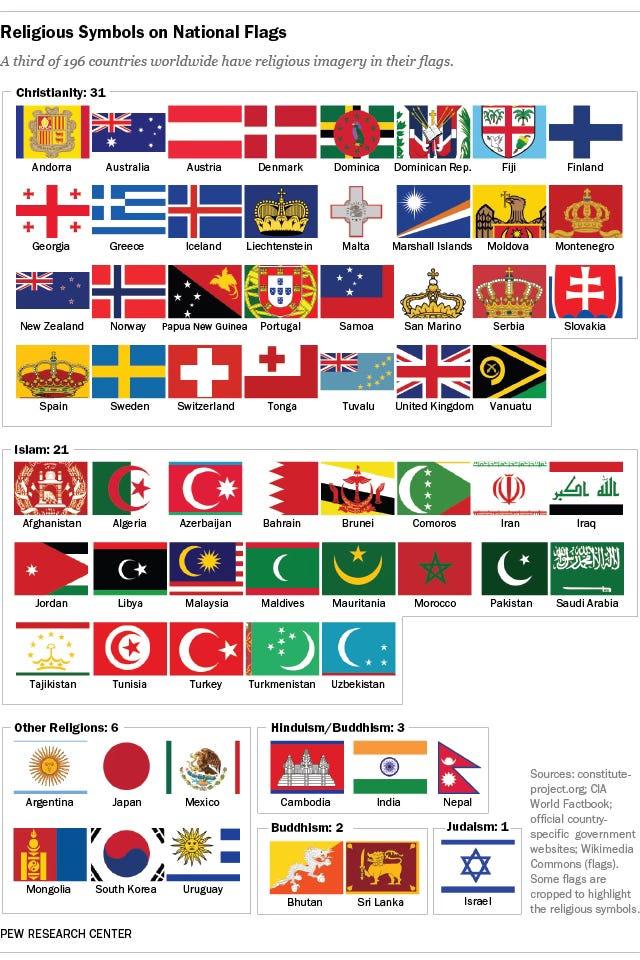
Christianity is more than a religion. For hundreds of millions of people, Christianity is a national and cultural identity that has nothing to do with personal faith. This is the case in Europe.
Those with a Christian cultural identity may have never prayed directly to God and only attend church for funerals and weddings. But they live in a historically Christian nation, and that makes them Christian in the same way it makes someone Iranian or Greek.
Many nations enshrine this idea in their constitutions with the naming of a state religion. The King of Great Britain is authorized to rule by the Anglican Church. This is Christianity as ethnicity and civilization.
To draw a parallel from largely agnostic modern Israel, Naor Narkis says, “What defines us (Jews) is our language, and our heritage, but doesn’t involve faith in a god.”
3.5 Million Parachurch Organizations
Then there’s the parachurch universe. According to research from Gordon-Conwell University, there are 3.5 million Christian agencies worldwide — organizations addressing everything from lack of access to the gospel, to clean water, to inclusion of LGBTQ in clergy, to homelessness, drug addiction, human trafficking, orphan care, right to life, legal reform, and political action.
It’s an industry.
It’s hard to know where to draw the line on what is and is not part of Christianity. For example, is an orphanage run by Christians part of Christianity? Sure.
How about the non-profit that runs the fundraising that runs the orphanage? Okay, that also.
How about the Christian credit card processor that serves churches and non-profits so they can receive donations? Is that Christianity?
How about the Christian investment company that oversees the retirement fund for the missionaries who run the orphanage?
How about the funds they invest in?
It’s hard to see the exact line.
Then, There’s Christianity, Inc.
There are millions of corporations and profit-driven businesses generating billions of dollars in revenue directly or indirectly attached to Christianity.
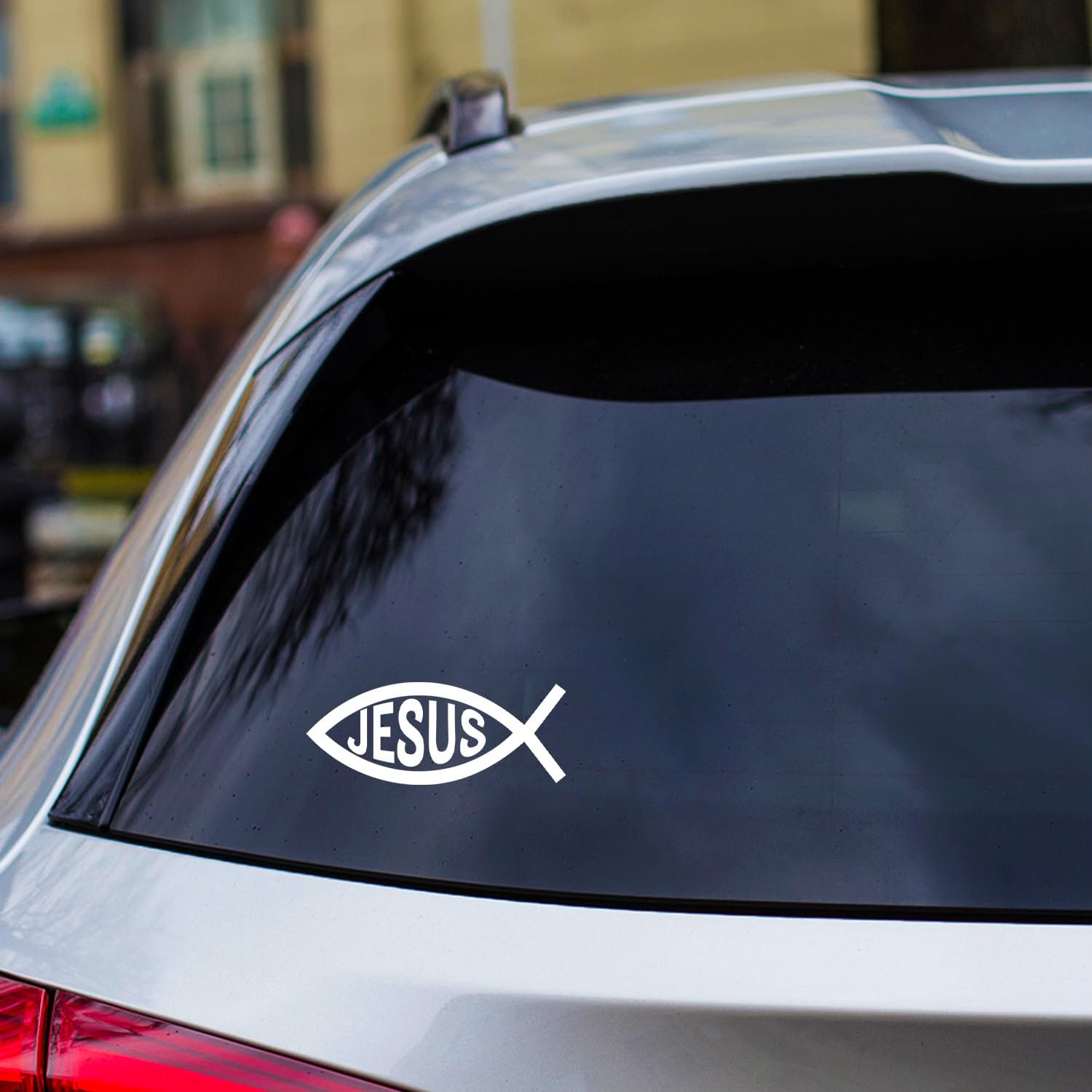
The fish sticker business alone is a blood sport.
There’s big bucks in fish stickers. Millions have been sold. It’s a contact sport. When Evolution Designs released “the Darwin fish” with feet (as a mockery of those who don’t believe in evolution), 3D Witness Enterprises responded with their Jesus fish eating the Darwin fish. Glorious.
In the United States alone, 350,000 Christian communities are legally incorporated. They own billions of dollars of real estate and receive billions in cash flow annually with very little reporting.
Add to that hundreds of universities, publishing houses, retreat centers, music labels, television networks, hospital systems, Christian law firms, sound and lights companies, church security companies, and companies making those tiny communion wafer packets that are generally impossible to open.

You want more?
Christian safari companies in South Africa. You can do a mission trip and also bag a rhino.
Clerical clothing manufacturers (You won’t find backward collars at Macy’s)
Companies making hand-cranked transistor radios for underground churches.
And of course, Chick-fil-A — which some call, “God’s fast food”. (Shout out to Chick-fil-A—how about some gift cards?)
We’ve got
Christian T-shirt companies
Agents handling only Christian comedians & ventriloquists
Christian Greeting Card companies like Precious Moments
Christian dating sites
Christian cruises with the Gaithers, etc. etc.
There’s Christian Tourism: Branson, MO, the “Christian Las Vegas”. Entire industries revolve around pilgrimage destinations in Israel, Turkey, and other historically significant locations, with busses, tour guides, olive-wood carving companies, relic makers, anointing oil bottlers, museums, etc.
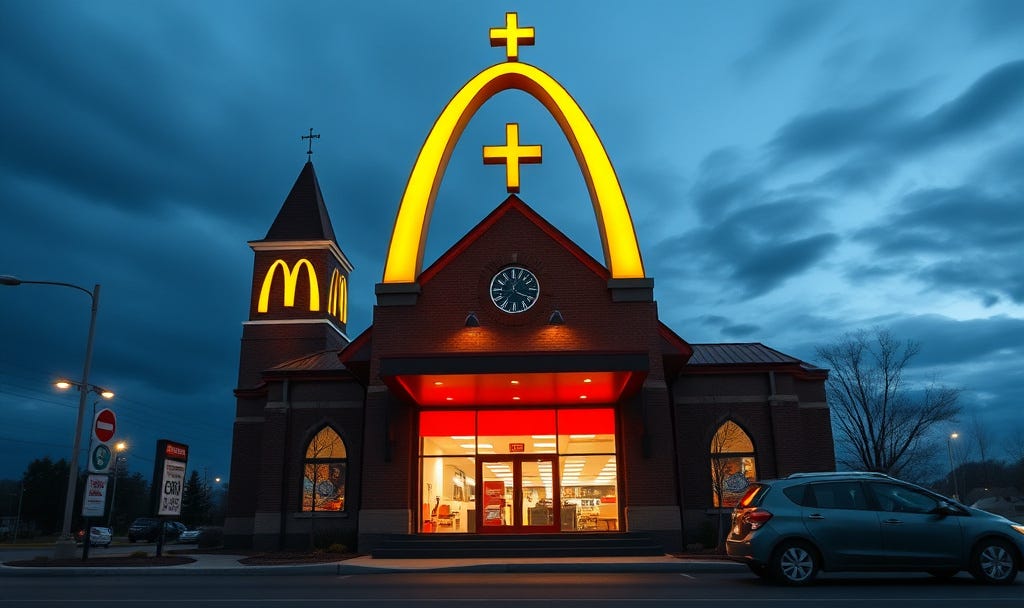
The best analogy I have is this: imagine McDonald’s with no rules. Anyone, anywhere in the world can put up the golden arches and call it McDonald’s — and they can do whatever they want inside the building. Make it a skating rink, a day spa, a hardware store, or serve food of any type. No quality control. No governing body. No one to call for permission. Anyone anywhere in the world can start any enterprise they want and attach it to the Christian cause through their branding and activities.
That’s Christianity today.
Some parts of the Christian Enterprise are sincere and beautiful. Some have gone badly off track. Some started faithfully but then unraveled as they went along, maybe at the peak of their visible success.
This is not a new problem. The church has wrestled with the tension between the institutional and the spiritual since its earliest days. But the scale of it today is genuinely unprecedented.
Humans Organize Things
Over the centuries, human beings did what human beings always do. We organized the movement. First, it was a movement, and then it was a governmentally empowered church system which spawned those trades that were attached to supporting Christian causes like builders, stone masons, weavers, candle-makers, etc. Over the past two millennia things just kept mushrooming in every direction as people got one great idea after another.
None of this was malicious. Organizing is simply how humans handle ideas they care about deeply. But over time the headless structure grew unbounded and lost its focus.
And today Christianity has long overwhelmed the boundaries of any known religion.
My Working Definition of Christianity
So here is my honest, eyes-open definition of Christianity:
“Religion, culture, businesses, initiatives, and assorted enterprises somehow related to the story and person of Jesus of Nazareth.”
Not inspiring, I know. I’m just trying to be accurate so we can begin to discuss Christianity intelligently.
Now you might think that all this crazy human chaos is rubbish and we should all repudiate it and walk away, but here’s what’s ironic….
Astonishingly, through these ungoverned, unplanned, random, and sometimes corrupt human creations — God has done extraordinary things anyway.
Do you think I’m overstating?
I’m not just talking about small good deeds scattered around the edges of history. I mean that there’s a mystery in this mess.
Yes, mistakes have been made, and people within this enterprise have gotten a million miles off course. Yet somehow this headless enterprise has created things that fundamentally reshaped life on this planet for everyone, including people who want nothing to do with Jesus.
Here are just a few.
The concept of universal human dignity — the idea that every person, regardless of race, gender, class, or ability, bears the image of God and deserves to be treated with dignity — that is a Christian idea. It is not found in ancient Greek philosophy or Roman law. It was Christianity that first insisted that slaves were full human beings made in God’s image. It was Christianity that built the first hospitals, the first orphanages, the first universities.
The abolition of slavery in the Western world was driven overwhelmingly by Christians — William Wilberforce in England, the evangelical abolitionists in America. The civil rights movement was led by a Baptist preacher whose entire vision was drawn from the Sermon on the Mount.
Modern science was largely developed by Christians who believed that a rational God had created a rational universe that could be understood through rational inquiry. The rule of law, limited government, individual conscience — all deeply shaped by Christian thought.
Christianity is the foundation of Western civilization, which has brought two thousand years of growing prosperity to this entire planet. Every single one of us — whether we follow Jesus or have never heard of him — owe this ungoverned, messy, sometimes embarrassing enterprise called Christianity an enormous debt.
I say this after 45 years in ministry, having seen the church at its absolute best and its absolute worst. Yes, you can travel the world and find people who have been deeply, genuinely wounded in churches and Christian organizations. That is real and it matters. That’s what this podcast is about.
But you can also find millions — I mean millions — who are now free from an unbreakable bondage because of the actions of people within Christianity. They are free from addiction, rescued from trafficking. They’ve been cared for after war took everything from them. Like so many, they have found a local community that consistently held them up while they the hard work of living out their lives.

All because— somehow—our amazing Jesus does his work even through this ungoverned, imperfect enterprise. Sit with that for a moment.
That alone is a miracle.
Unlike a franchise system such as McDonald’s — where a central authority controls how each location operates — Christianity has no global governing structure, and yet….the mystery and the mess.
The Paradox
There is always this deep paradox at the heart of Christianity.
On one hand, the Christian world itself is fragmented, disorganized, and sometimes so deeply flawed and contrary to the very values of Jesus. On the other hand, through this very imperfect system, extraordinary good has somehow been accomplished.

It’s like a tile mosaic of life. The individual pieces might not actually match the project but step back from the tiny broken pieces and look at the whole mosaic created by Christianity, and something remarkable appears.
Despite its flaws, Christianity has often been a powerful force for compassion, justice, and human flourishing. I find that so amazing.
But here’s the thought I’ll leave you with today.
The early church had no buildings. No banks. No benefactors. No publishing houses. No political action committees. No fish stickers.
They had one thing: a living connection to Jesus. He held all authority. He was the magnetic north around which everything else oriented.
With that single center, a small group of fishermen and tax collectors spread a faith across the entire Roman Empire within 300 years.
The power was not in the complexity of their enterprise. The power was in the centrality of Jesus, which may be the most important lesson for the modern church.
That’s the only way forward. And that’s exactly what ReJesus Everything is about. That is the challenge before us today:
If the first Christians turned the world upside down with nothing but a living connection to Jesus, what might happen if the modern church found its way back to that center again?
Here’s our discussion question for today:
“The early church had no buildings, banks, or institutions — just a living connection to Jesus — and turned the world upside down.
What do you think the modern church would have to give up to get back to that kind of center?”
Drop your answer in the comments. I read every one, and I’d love to hear your story.
Thanks for joining me on Grounded. Let’s ReJesus Everything!
Send me your questions and I’ll respond.
The Next Episode
Which brings us to the question that this whole season is building toward: Did Jesus establish Christianity? And can it be saved?
I’m going to tackle that question fully in the next episode.
Please help us share the Grounded podcast with your friends. There’s no algorithm driving the expansion of our audience, only you sharing the value you find in this discussion with your friends.


