Many people begin their spiritual journey after answering this question: Is God real?
It’s a vital question. Philosophers wrestle with it. Scientists challenge it. We all, in our own quiet moments, feel the weight of it. And rightly so.
But after Sherry and I had served for 25 years in the 1040 window, the home of every world faith where millions of gods are named and sacrificed to, I had to face another question:
Are the gods also real?
I’m not asking if there are idols of wood and stone that sit in temples. We have lived within sight of temples filled with images of deities for the last 18 years. We have sat in Buddhist temples for hours observing and interacting with the worshippers. We have witnessed processions and festivals to deities.
The real question is whether the deities that are worshiped around the world are just products of superstition and folklore or actual, intelligent, spiritual beings with real authority, territory, and often malevolent influence over the course of human history. Are the “gods” real or not?
I was watching Jordan Peterson’s video series on Genesis and was surprised to hear Dennis Prager of Prager University say that only very recently has he even considered the possibility that there might be a real Satan. That’s how strong his monotheism is.
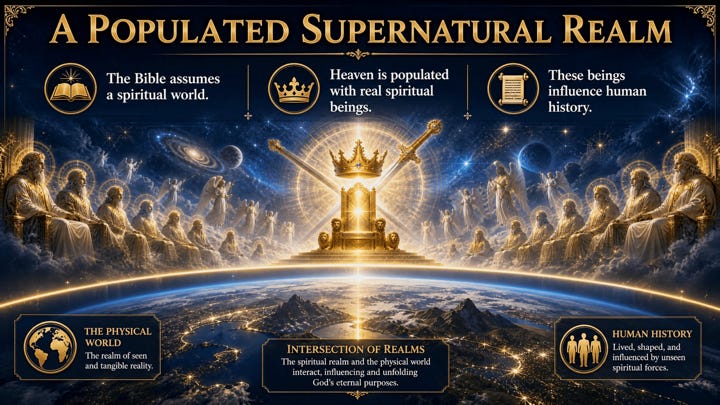
I felt that I had to answer this question of whether the gods are real not because of Asian polytheism, but because of the Bible. The writers of the Bible simply assume it. From Genesis to Revelation, Scripture operates from a foundational worldview that the space around us is populated with intelligent beings we cannot see and that these beings engage human society and are a real factor in developments within our history.
If you just ignore dealing with this, you’re reading the Bible with a fundamental blind spot AND you’re going to miss some of the most powerful messages the Bible is trying to transmit to you.
The Elohim: A Category of Being
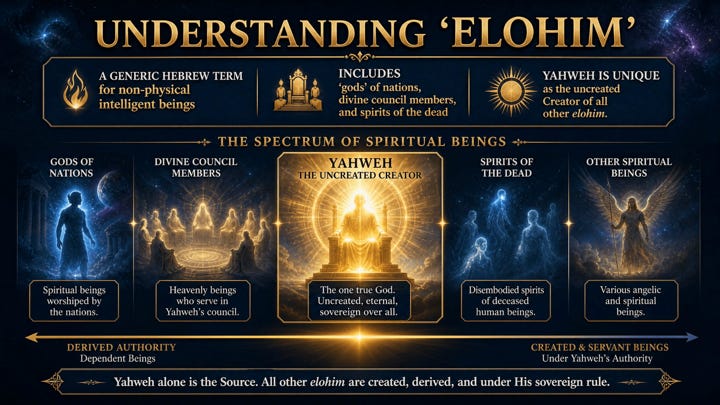
In Hebrew, these spiritual beings are called elohim—a plural, generic term that appears throughout Scripture without explanation or introduction. The psalmist refers to humans being made “a little lower than the elohim“ (Psalm 8:5). Job describes divine beings gathering in the council of the Lord. Daniel encounters an angelic hierarchy of intelligence and power. And yet, most modern readers treat these references as metaphor or mythology, when the biblical writers intended them as straightforward theology.
Elohim isn’t exclusive to God. Yes, it’s used for Yahweh, the uncreated Creator. But it’s also used for members of the divine council, the “gods” of nations, even the spirits of the dead in certain contexts. It’s a category—describing a type of being, specifically those who exist in non-physical form.
Think of how we use the word “human.” It can mean a specific person (like me), or it can refer to the entire species of us. The same logic applies to elohim. It’s a classification. And while Yahweh is elohim, He is utterly unique—the uncreated Creator of all other spiritual beings. He’s the Lord of lords, the elohim of elohim. Another way of putting it is that, while Yahweh is an Elohim, no other Elohim is Yahweh. He stands in an uncontested position as Creator of everything that exists.
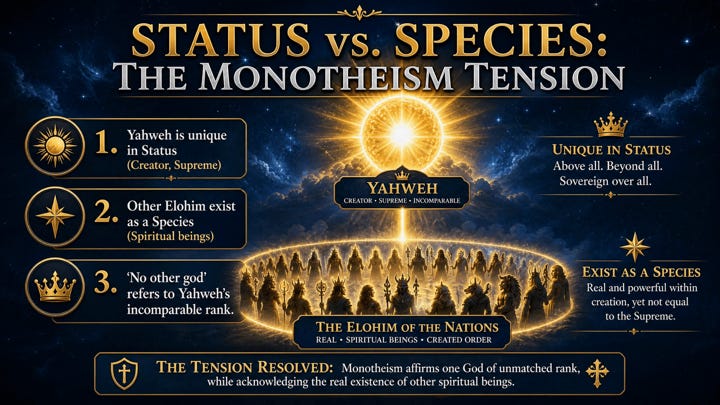
This distinction matters. It’s the difference between monotheism (belief in one God) and the biblical worldview (which acknowledges one Creator and multiple intelligent, created spiritual beings). Some scholars say we would do better to say that the Jews were commanded to monolatry (the worship of only one Elohim, YHWH), not monotheism (the belief that there are no divine beings except one). Opening your mind to allow for the existence of the multiple Elohim mentioned in the opening verses of scriptures reshapes everything that follows in the Bible.
God’s Irrevocable Word: The Foundation of Everything
If the populated cosmos is the backdrop of Scripture, then God’s irrevocable decrees are the framework that makes sense of the entire drama.
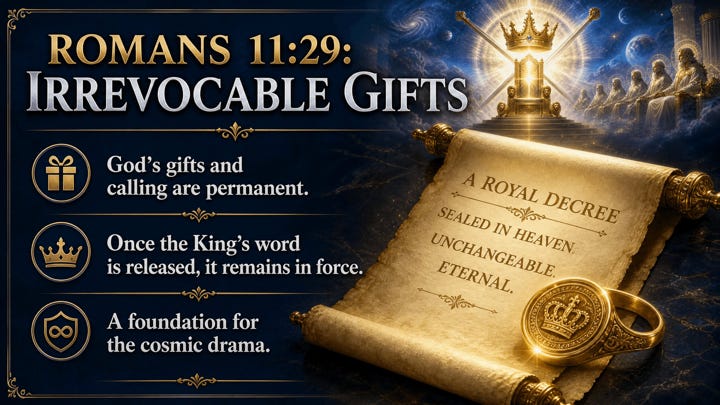
Romans 11:29 states: “For the gifts and the calling of God are irrevocable.”
Most of us skim past this verse. We apply it to individual callings—”God won’t take back the purpose He’s given you.” But Paul’s statement goes far deeper. He’s articulating a principle about God’s fundamental character: When Yahweh assigns authority, grants a gift, or makes a decree, it cannot be revoked. Not because He lacks the power. But because His character demands He keep His word. His faithfulness is absolute. Once His commands are released, they stand in force forever.
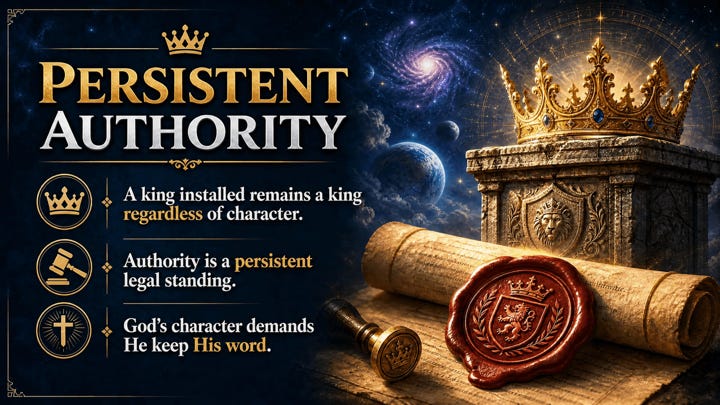
Consider the implications. If God makes an irrevocable decree, then that decree remains in force regardless of whether the recipient remains faithful. A king appointed by God remains a king—his authority is a real, persistent legal standing—even if he becomes corrupt or rebellious. This isn’t arbitrary. It’s God’s commitment to the stability of His own established order. To revoke the word would be to make God capricious, His universe unpredictable, His promises fragile.
In the creation narrative of Genesis 1 and 2, God creates the universe by making verbal decrees.
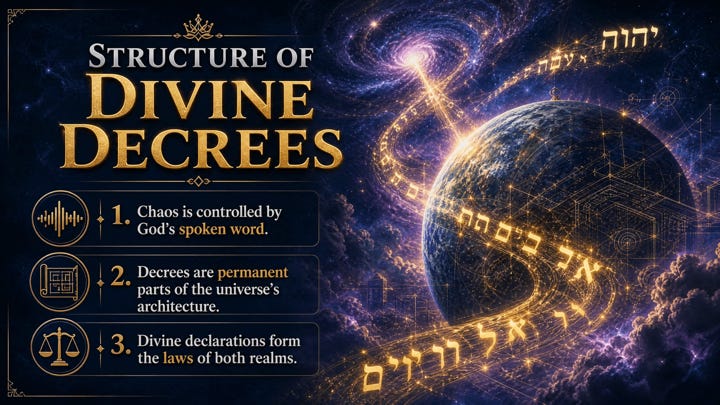
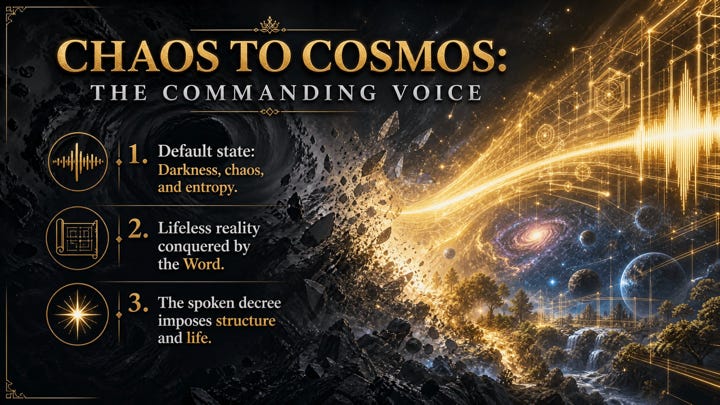
Go back to Genesis 1. What do we witness? Chaos. Formlessness. Darkness. And what imposes order? The voice of Yahweh: “Let there be light.” “Let the waters be gathered.” “Let the earth bring forth.” Each spoken word is a divine decree that brings cosmos out of chaos. These decrees become permanent. They form the architecture of creation itself—the laws governing both physical and spiritual realms.
Isaiah 40:8 reminds us: “The grass withers, the flower fades, but the word of our God will stand forever.”
Jesus Himself says (Matthew 24:35): “Heaven and earth will pass away, but my words will not pass away.”
And again (John 10:35): “Scripture cannot be broken.”
This isn’t sentimentality about the Bible as a book. It’s a statement about the nature of God’s spoken commands. They create something in the substance of reality itself. Unbreakable. Eternal. The fabric holding creation together.
The Crown: Human Dominion
Against this backdrop, God makes one of His most consequential declarations—one that sets the stage for everything that follows in Scripture:
Genesis 1:27-28: “Then God said, ‘Let us make mankind in our image, in our likeness, so that they may rule... So God created mankind in his own image, in the image of God he created them; male and female he created them... Rule over the fish of the sea and the birds of the sky and over every living thing that moves on the ground.’”
Dominion. Authority. Rule. Given not to the elder spiritual beings. Not to the celestial powers who had existed for ages. But to humans—fragile, physical, mortal humans.
Only humans will be the rulers of God’s world. He has installed us as kings over his creation. Humans, not angels or any other celestial power. God’s eternal decree installs humans, with all of their weakness and frailty, as the image of God for planet Earth.
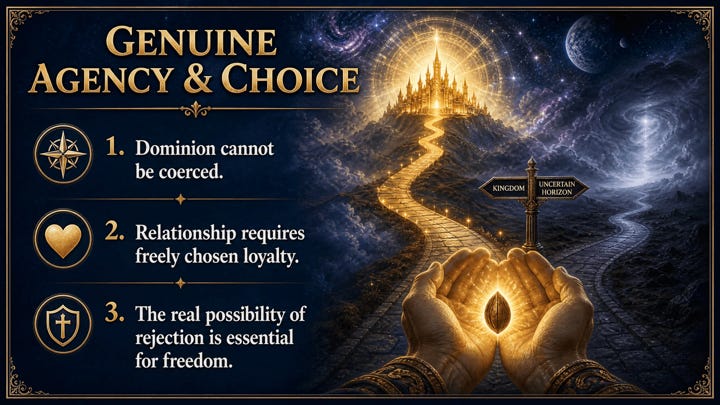
This is the crown jewel of God’s creation: the capacity to exercise authority, to steward, to choose. It’s the power to have true agency: to decide what kind of person you will be and what you will do and not do, and how you will affect the people, animals, and world around you in your little domain assigned by God. Agency is woven into your very identity as someone made in the image of God. Your dominion over creation isn’t incidental. It’s irrevocable. It’s part of what makes you human. Caring and nurturing for all the life on this planet is the reason for which we exist.
Here’s the paradox that drives the entire cosmic drama: genuine dominion cannot be coerced. It’s built on real agency. Real choice. Real consequences. God’s own name means freedom and complete agency—“I am what I am.”
This can only happen if we truly have the ability to follow or not follow God, to be loyal to him or as disloyal as we want to be, to be a positive force in the world, or a true monster.
This is the risk God takes in creating beings in His image. And it’s the reason there can be spiritual rebellion in the cosmos—which we’ll explore in future episodes.
Why This Reshapes Everything
If you understand that heaven is populated with real spiritual beings, and you understand that God’s decrees are irrevocable, then you’re ready to see the biblical narrative as it truly is: not a story about humanity’s moral progress, but a cosmic drama about the reclamation of humanity’s stolen dominion.
You’re ready to understand why the systems of our world—media, government, finance, education, the arts—seem always bent against God’s order.
You’re ready to grasp why Jesus had to become human and live a perfect human life to reclaim what humans had lost. You’re ready to see yourself not as a passive believer waiting to die and go to heaven, but as an active agent of the Kingdom right now, reclaiming lost territory.
Most importantly, you’re ready to understand your own significance. You are not a minor character in a story controlled by cosmic forces. You are a steward of real authority, a carrier of divine image, an agent of restoration in a world under occupation.
This is the foundation. The populated cosmos. A world filled with intelligent beings, both seen and unseen. Two realms overlapping on this one-of-a-kind planet. Our planet as the meeting point between the heavenly and the physical realms, with man as the connection. We are created from the carbon of this planet. Our feet are grounded in the earth, but our head is in the heavens. We have the ability to think and have a vision for the future and the capacity to interact with God and, surprisingly, with the Elohim as well. These pages of scripture tell us. Humans enter into conversation with members of the Elohim. Jacob wrestles with one and has his hip knocked out of a socket. Daniel receives a map of the future rise and fall of empires from a member of God’s inner circle. Humans have the amazing capacity to tend to the animals and speak to God himself.
The irrevocable decrees. Your irrevocable dominion.
In the next episode, we’ll explore the rebellion—how some of these spiritual beings grew jealous of humanity and sought to seize what was never theirs. We’ll see the “fingerprints” of this rebellion on the very pillars of our society. And we’ll begin to understand why the world feels like occupied territory.
But first, sit with this: your purpose is not borrowed. Your authority is not provisional on your being fit for the job. Your calling as God’s king or queen on planet Earth is woven into the cosmos itself.
Do you have a destiny secured by God’s eternal decree. Let’s live like it.
Ready to dig deeper into the ancient biblical worldview that reshapes your faith? Get the full series and discover how ReJesus Everything is calling believers back to the Jesus of Scripture—not the domesticated version we’ve inherited, but the King who reclaimed the cosmos. Order here.