I know you’ve wondered this. I have too. If the Almighty can speak galaxies into existence, why not just snap His fingers and blast away the devil and all spiritual darkness? Why not open the heavens and incinerate the rebel powers with raw divine force?
But the answer isn’t about God’s power. His power was never in question. The answer is about His character—and specifically, about His stubborn, unwavering commitment to His own word.
In our last episode, we established that God’s gifts and callings are irrevocable. He built our world by using His voice and speaking commands. Those commands become the fabric of the universe. When He makes a decree, it stands forever.
When He gives humans the gift of dominion over the earth in Ge. 1, it remains our dominion, even when the holder of that dominion fails God. If God makes a person a king they may be a great king or a horrible king, but they will be the king for the rest of their life. God’s gifts are permanent. He stands by his word. The universe exists because his word cannot pass away. God governs his world by faithfulness to His word.
So although he had the ability, and they surely deserved it, YHWH wouldn’t just swat the rebels like flies. There’s no point building a society of free-willed beings if all of them only obey you because you threaten to nuke them if they don’t.
Any successful society on earth must be a true collaboration between God and his higher creations.
Secondly, dominion over the earth wasn’t given to Heavenly Beings. It was given to humans. To us. Irrevocably. Therefore, since humans are already the ones in charge of this planet, it was up to the human to defeat the cosmic powers who had seized this power and take back dominion over the earth.
That created a cosmic dilemma. A human had to reclaim what humans had lost. But no ordinary human could defeat the host of celestial beings who had seized control. The domain authorities, the territorial powers, the principalities that rule over nations—these aren’t enemies you fight with swords or missiles. A mortal can’t stand against elohim if the battle is going to be power vs power.
God could have done it alone, but that would have violated the very structure He established. From the first day of our creation, He declared that humans shall have dominion over all of his creation.
Only a human could take back from this occupation army the dominion that already belongs to humans. The solution was the Incarnation—the God-man. Fully divine, fully human.
Only a human had the legal standing to reclaim dominion that was given to humanity. Only an unblemished human, operating within the bounds of human limitation, could undo what humanity had lost.
But that human also needed divine power, because fighting celestial forces requires power beyond human capability.
Into this dark arena steps our champion, Jesus Christ—perfectly human, perfectly divine, wielding both the legal standing to act and the power to enforce the restoration of human dominion on planet earth.
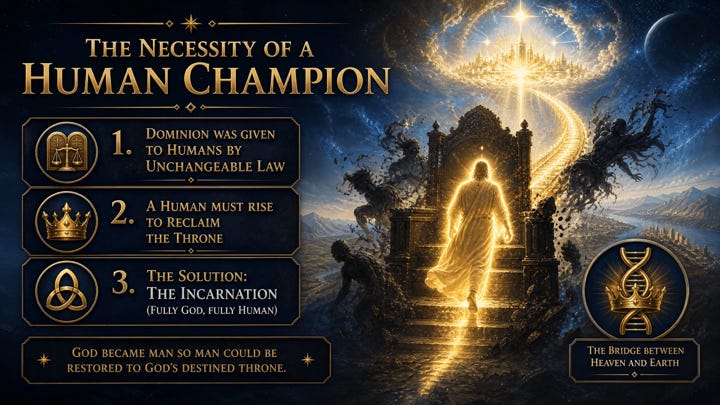
This is the strategic brilliance of the Incarnation. Jesus is the Human Champion. The one being in all of creation who could rightly reclaim dominion while possessing the power to pull it off.
He was aware of this calling.
You see it in the wilderness temptation. Satan didn’t tempt Jesus to do evil in the way we usually imagine. He tempted Him to bypass being bound by the human condition. He tempted him to meet his own human needs and to engage the fallen powers using the supernatural abilities of God. He baited him to reclaim authority without going through the cross.
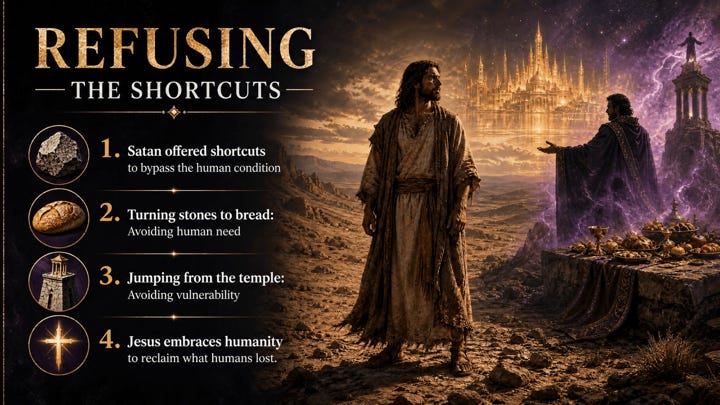
Turn stones to bread. Use divine power to escape hunger. Jesus refused. He limited Himself to what was possible for a human. He stayed hungry.
Throw yourself from the temple. Force God’s hand. Demand the miraculous rescue you deserve as the Son of God. Jesus refused. He wouldn’t use His divine power to bypass human limitation. He chose to remain subject to the consequences of His own actions.
Show Respect to Satan for all the kingdoms of the world. The ultimate shortcut. The rebel powers offered Jesus the very dominion He came to reclaim—minus the suffering. Just acknowledge that Satan’s authority is legitimate. Take the kingdoms without the cross.
Jesus refused absolutely. Every single time, He stayed within the boundaries of the human condition. He chose the hard path of perfect human obedience, perfect trust, even in agony. He would win not through divine force, but through living out a loyal life as a righteous human.
That brings us to the pivot point of cosmic history.
The cross wasn’t just about personal salvation. It was a legal revolution.
The rebel powers had used the law as their weapon. They had a case. Humanity was too sinful, too disloyal to God to exercise dominion on the earth. We had proven ourselves unfit. Every failure was recorded. The Bible uses a specific legal term for this: cheirographon. A handwritten certificate of debt, written in the debtor’s own hand, self-condemning in court.
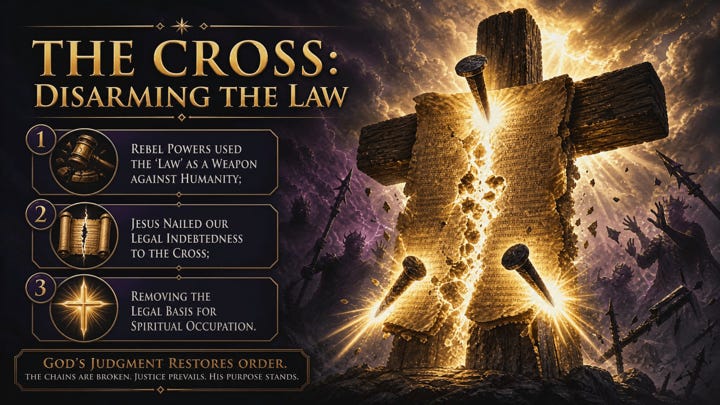
The powers could point to this document and say, “God, your own law condemns them. Dominion was given to humans, but look at the evidence. They are unfit to rule. The contract is void.”
But, according to Paul, Jesus did something unexpected on the cross. He took that record of debt—all our sin, all our shame, all our legal condemnation—and He became it. Then He nailed it to the tree in His body.
Colossians 2:14-15 says He “canceled the record of debt that stood against us with its legal demands. This he set aside, nailing it to the cross. He disarmed the powers and authorities, he made a public spectacle of them, triumphing over them by the cross.”
He disarmed them of their right to assert the need to be at least a provisional government over the Creation. Jesus didn’t destroy them yet. He removed their primary weapon—the legal justification for humanity’s oppression. The cross was a cosmic act of legal liberation. It canceled the debt that justified the occupation.
Jesus didn’t just die so we could have nice feelings about God and go live in heaven after we die. He died to legally disarm the powers that had oppressed humanity since the beginning, removing their supposed grounds for taking dominion (like forcing a drunk driver out from behind the wheel of his own car).
The story culminates in the Resurrection.
In Matthew 28:18, the risen Jesus declares: “All authority in heaven and on earth has been given to me.” Not partial authority. All authority. Every corner of the cosmos.
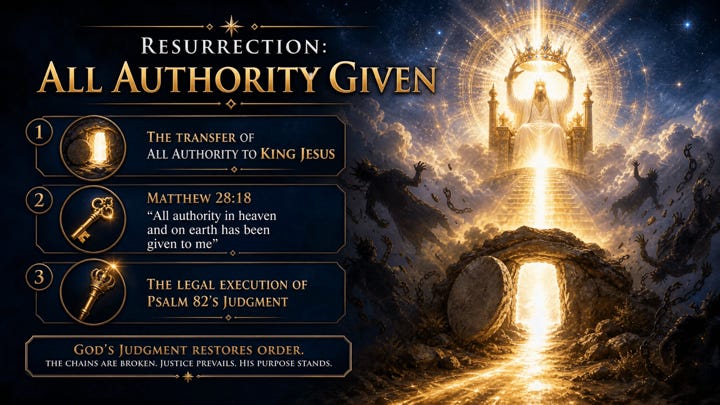
This is the legal transfer of dominion from the defeated rebel powers back to the rightful King—a human being. A physical, resurrected human. He appeared in a body. He ate fish. He bore the marks of crucifixion.
Then comes the Ascension. A physical human body is now seated at the right hand of Yahweh. This echoes Psalm 110:1, where Yahweh invites a second figure to sit on His throne and rule.
Paul is explicit in Ephesians: Jesus is seated “far above every rule and authority and power and dominion.” Those aren’t poetic flourishes. Arche, exousia, dynamis, kyriotetes—these are technical terms for the territorial powers that rule over nations. The same beings allotted the peoples at Babel. The same powers sentenced in Psalm 82.
Jesus is seated far above every single one of them.
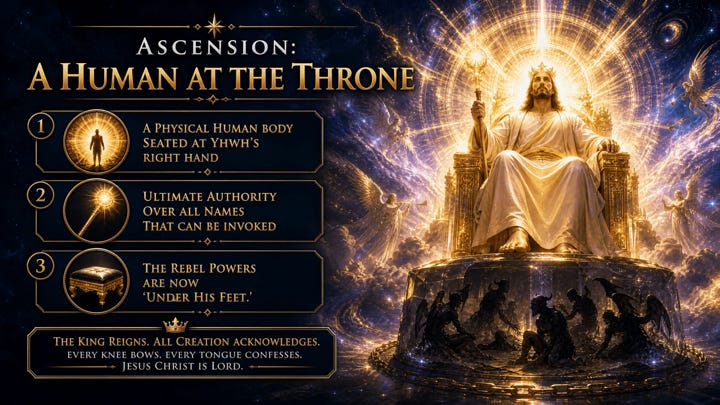
A human now holds dominion over the powers that occupied the earth. Every rebel power is under His feet, waiting for final judgment.
This is the answer to ending refrain of Psalm 82: “Arise, O God, and inherit all the nations.” God inherits the nations—by enthroning a man.
The dominion lost by the first Adam, forfeited at Babel, has been reclaimed by the Last Adam. Here’s what changes everything: we don’t have to wait for heaven to participate in this. One human has done it perfectly. And one human doing that is enough.
Jesus has ascended the throne. He is King of earth and heaven, and all powers are subjected to Him. We have authority through His authority as we live in alignment with Him. We can now rule our little worlds in Jesus’ name—not through brute force, but through the same stubborn faithfulness that won the cosmos back in the first place.
The war is won. The King is crowned. The only question left is whether we’ll live like it.
Ready to dig deeper into the ancient biblical worldview that reshapes your faith? Get the full series and discover how ReJesus Everything is calling believers back to the Jesus of Scripture—not the domesticated version we’ve inherited, but the King who reclaimed the cosmos. Order here.