

When you look at the major systems of our civilization—government, finance, education, the arts—there’s a pervasive sense that something is off. Not just slightly misaligned, but fundamentally bent away from God’s order. Institutions designed to serve justice become instruments of oppression. Systems meant to transmit truth become tools of propaganda. Culture meant to reflect beauty becomes a celebration of darkness.
We often blame individual corruption, dysfunctional systems, or that it’s just human nature. And yes, those factors matter. But the Bible offers a more unsettling explanation: we’re living in occupied territory.
The Envy That Never Dies
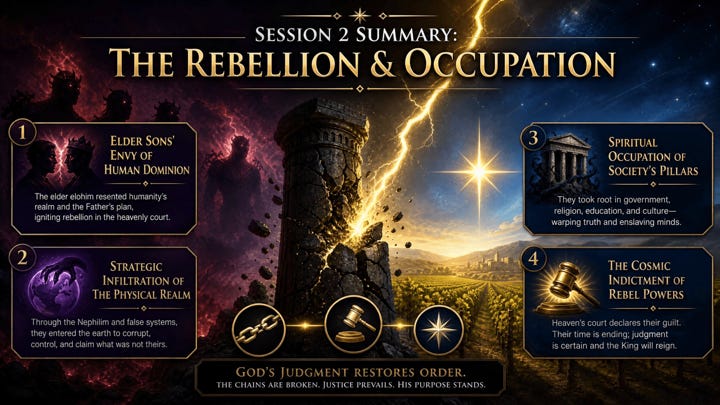
Imagine you’re one of the elder elohim—a spiritual being who has existed for ages, powerful beyond human comprehension, serving in God’s heavenly court. And then, God creates humans. Fragile. Physical. Temporary. And He crowns them with glory and honor. He gives them dominion over the earth.
You might expect the response to be graceful acceptance. These elder beings were assigned to be shepherds, tutors, guardians to help humanity steward the world. A sacred role. A partnership.
Instead, according to Scripture, envy festered in many.
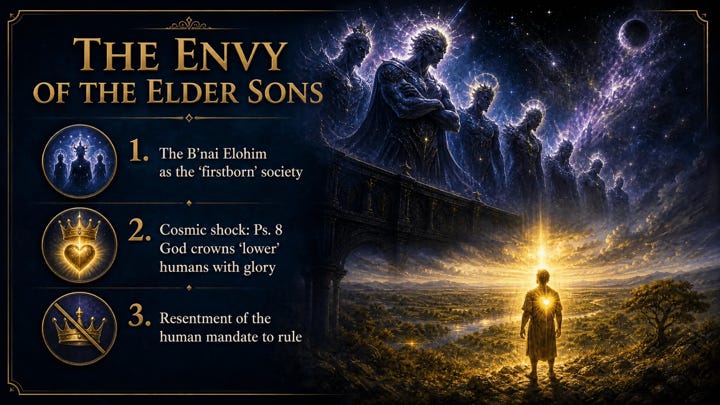
Psalm 8:5 captures the shock: “You have made them (humans) a little lower than the elohim and crowned them (humans) with glory and honor.”
The implication is clear: this was unexpected. Humans—shorter-lived, weaker, more vulnerable—were exalted above the elder spiritual beings in terms of delegated authority regarding planet Earth.
The beings who had been closest to the throne, who had served longest, found themselves subordinate on Earth to creatures they might have viewed as inferior.
This, it seems, is the birthplace of the cosmic rebellion. Not from ignorance—from wounded pride. From the refusal to accept God’s mysterious choice to place authority for this world in human hands.
The Hunger for the Physical
Even to powerful spirit world beings, according to Genesis chapter 6, humans are beautiful. Part of our attraction is that we are part of the physical reality. We have bodies and experience being alive through our bodies. These spiritual beings don’t just want power—they want physicality. They want bodies. They want to feel.
There’s something unique about physical existence that transcends mere utility. To taste. To touch. To experience the weight and texture of the material world. To inhabit a body and feel its sensations. This is not something disembodied spirits possess. And according to the gospels, they want it.
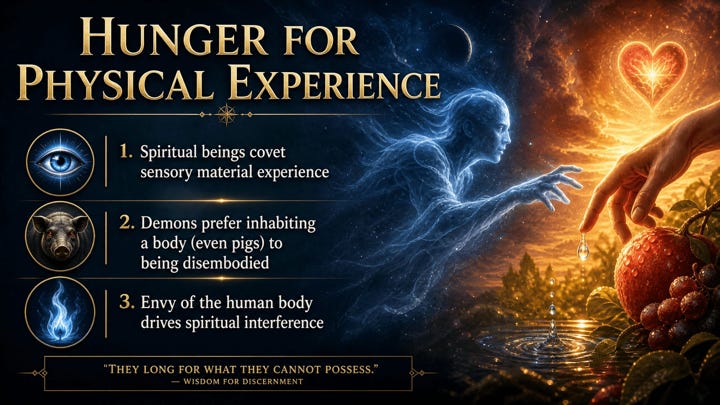
The demoniac of Gadara illustrates this graphically. When Jesus confronts a legion of demons, they beg Him with a specific request: “Send us into the herd of pigs.” Not freedom. Not peaceful annihilation. Pigs. They would rather inhabit filthy pigs than remain disembodied. Why? Because physicality itself is the prize.
This hunger drove them to something far darker. Genesis 6 describes how the bene elohim—the sons of God—”saw that the daughters of humans were beautiful, and they married (took) any of them they chose.” This wasn’t romance. It was strategy.
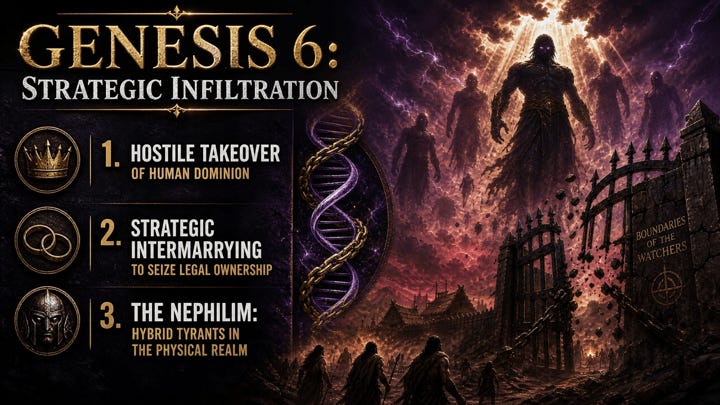
By interbreeding with humans, these rebel powers sought to do something brilliant and horrifying: they attempted to merge with human bloodline. If they could corrupt the human line, they could seize claim to human dominion. They could make the earth theirs not by stealing it, but by infiltrating it, by becoming part of it.
The result, according to the Genesis account, was the Nephilim—hybrid beings trying to rule the physical realm with absolute authority. Giants. Tyrants. The visible manifestation of spiritual rebellion in physical form. Most ancient cultures have stories of superhuman beings that were in the form of humans but were much larger and had impossibly great size and abilities.
God’s response was the global flood because this corruption and the ensuing violent downward struggle of human society threatened the very foundation of His irrevocable decree to humanity. Human dominion had to remain human. The bloodline had to be preserved.
But the spirit of this rebellion never died. It just adapted.
The Parable of the Tenants: A Cosmic Story
Jesus tells a parable that speaks directly to this rebellion, though most of us read it as mere social commentary.
Matthew 21:33-41: A landowner plants a vineyard, leases it to tenants, and goes away. At harvest time, he sends servants to collect his share. The tenants beat and kill them. Finally, he sends his son. And the tenants say: “This is the heir. Come, let’s kill him and take his inheritance.”
On the surface, it’s about corrupt workers. But read in context of the cosmic rebellion, it becomes something else entirely. I think the “tenants” are stand-ins for the rebel elohim—the spiritual beings assigned by God to help steward the earth for humanity. But they decided to squat on the property. To occupy. To claim ownership of what was never theirs to possess.
They saw humanity’s irrevocable gift of dominion and wanted it. They couldn’t take it by force—God’s word is unbreakable. But they could plot. They could scheme. They could be a provisional government that drags on and on. And when the Son came to reclaim the land that was rightfully His, their response was murder. “Kill him and we’ll get it forever!”
This parable reveals the core sin of the angelic rebellion: Coveting. The refusal to accept the order God established. The determination to seize what belongs to others.
The Fingerprints on Society’s Pillars
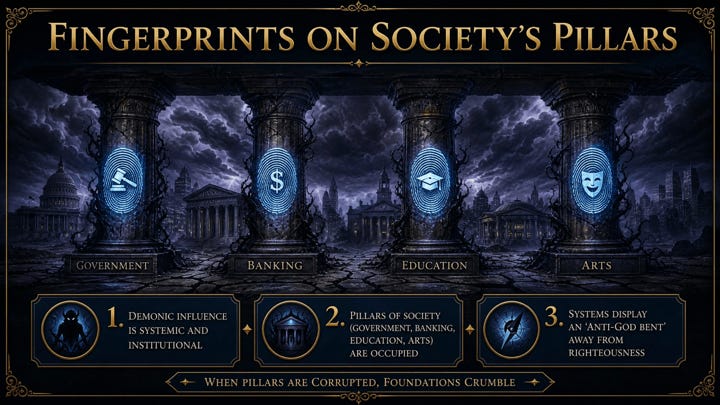
The rebellion isn’t abstract theology. It’s tangible. If we open our eyes, we can see it woven through the institutions that shape civilization.
Government everywhere consistently wants more and more control. This lust for power always corrupts it absolutely. Instead of justice, it becomes oppression.
Finance could be the stewardship of resources to make sure that everyone flourishes. Instead, the banking system in every nation becomes machinery for exploitation. The love of money drives the system to benefit the few at the expense of the many. Greed becomes structural.
Education that’s meant to transmit truth. Knowledge is a wonderful thing. But once the stewardship of knowledge becomes institutionalized it gets perverted. Young minds are indoctrinated rather than enlightened. The transmission of wisdom becomes the propagation of rebellion against God. Enlightenment is another word for independence from our Creator.
The Arts are designed to reflect beauty and divine creativity. Institutionalized, they become twisted into celebrations of darkness and rebellion. Beauty gets corrupted into obscenity.
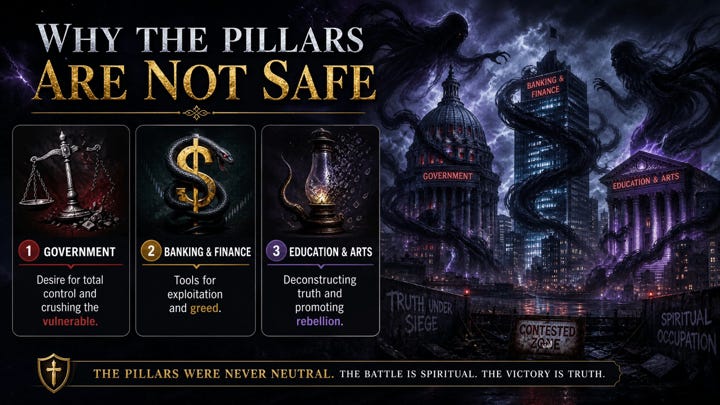
This isn’t coincidence. It’s not mere human sinfulness (though that’s present). Ephesians 6:12 names it explicitly: “Our struggle is not against flesh and blood, but against the rulers, against the authorities, against the powers of this dark world and against the spiritual forces of evil in the heavenly realms.”
These are intelligent, organized entities. They’re not just tempting individuals—they’re occupying entire systems, bending institutions toward their rebellion, marking civilization with their fingerprints.
The Divine Courtroom: Psalm 82
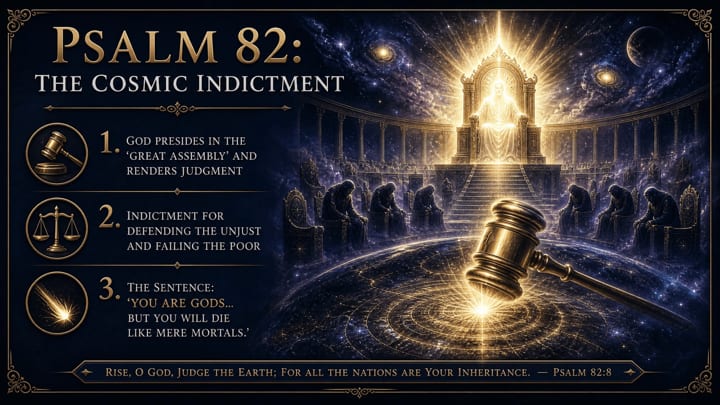
But Scripture doesn’t leave us without hope or clarity. Psalm 82 pulls back the curtain on the divine courtroom.
“God has taken his place in the divine council; in the midst of the elohim he holds judgment.”
Yahweh is presiding over the assembly of spiritual beings. And He speaks an indictment: “How long will you judge unjustly and show partiality to the wicked? Give justice to the weak and the orphan; maintain the right of the afflicted and the destitute.”
He condemns them for corruption. For defending the unjust. For failing to uphold the cause of the poor. For betraying their original stewardship role.
Then comes the sentence: “Nevertheless, like men you shall die, and fall like any prince.”
This is a legal proclamation—shockingly, it’s their death sentence. Their time is limited. Their authority is revoked. They stand condemned before the highest court in creation.
What This Means for You
If you understand that your world is occupied by intelligent spiritual powers bent on subverting human dominion, you’ll see things differently. The systems you navigate daily aren’t neutral platforms. They’re battlegrounds. They’re occupied territories.
But through Psalms 82 you also understand something crucial: their occupation of the pillars of human society is already judged. The sentence has been pronounced. The rebels know their time is short, and they fight with increasing desperation.
This is the moment we live in. The indictment has been issued. The rightful King is moving to reclaim His vineyard. Our response isn’t to despair at the occupation of our world’s power positions, but to see them clearly. To be discerning. To recognize the anti-God bent in the structures around you—not with paranoia, but with the clarity that comes from biblical realism.
The occupation is real. But it’s also—Praise God!— temporary.
Share this post.
If you’re enjoying this treatment of the Cosmic Rebellion please pass it on to your friends. Just click the button below.
In Our Next Podcast
The rebellion of the elder sons is the backdrop against which the entire drama of redemption unfolds. In our next episode, we’ll explore how a human—fully human, perfectly human—became the key to cosmic victory. Because only a human could legally reclaim what humans had lost.
Ready to dig deeper into the ancient biblical worldview that reshapes your faith? Get the full series and discover how ReJesus Everything is calling believers back to the Jesus of Scripture—not the domesticated version we’ve inherited, but the King who reclaimed the cosmos. Order here.

Stay grounded. God’s Lamb has conquered. His kingdom is advancing.
Every Blessing,
Chuck


